
AI upscaling and frame-generation guide
DLSS 4 vs FSR 4
DLSS and FSR are complete rendering pipelines that can affect image reconstruction, frame generation, latency, hardware support and GPU value. The better choice depends on the exact game, GPU, mode and visual target.
Exact specifications, prices, support and measured performance should be verified immediately before publishing or buying.
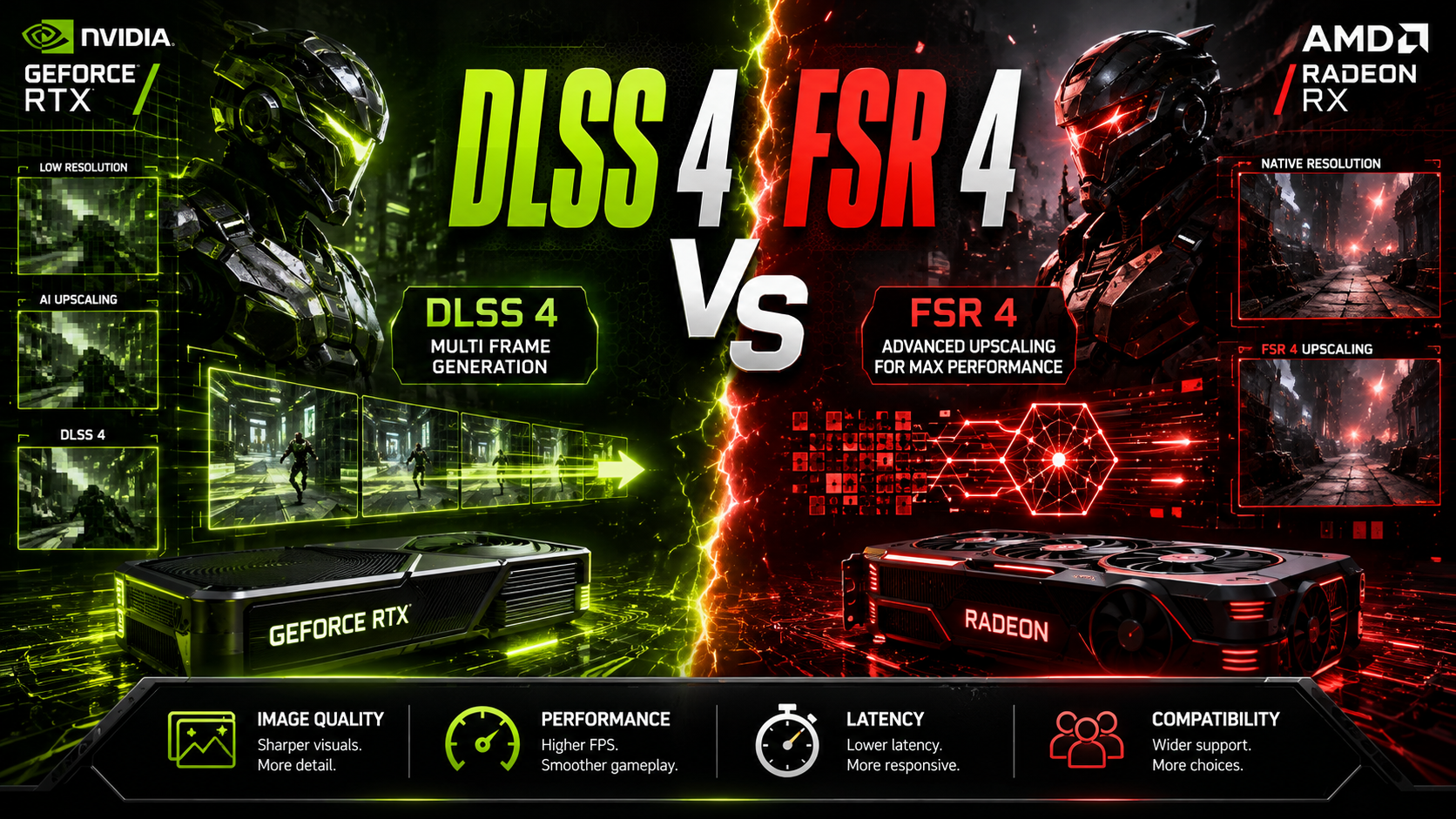
One-minute verdict
DLSS is usually the stronger NVIDIA feature ecosystem, while FSR can be the more flexible cross-hardware route
DLSS is generally the more compelling reason to choose a supported GeForce card when image reconstruction and NVIDIA integration matter.
FSR can be attractive when broader compatibility and Radeon support matter more. The result varies by game and implementation.
The decision framework
Two routes built around different priorities
This comparison focuses on the complete buying decision rather than one headline number.
DLSS 4
Designed around supported GeForce hardware and NVIDIA's rendering stack.
- GeForce-focused integration
- Image reconstruction and frame generation
- Strong buying feature in supported games
- Support should be verified by feature
FSR 4
Designed around AMD's ecosystem while maintaining broader reach in supported implementations.
- Radeon-focused integration
- Upscaling and frame-generation ecosystem
- Potentially broader hardware compatibility
- Version-specific support should be checked
Editorial fit overview
How each option fits real buyer priorities
These bars are qualitative editorial-fit graphics, not benchmark percentages.
DLSS 4 buyer-fit profile
FSR 4 buyer-fit profile
Animated decision map
What should decide the result?
- Internal render begins below output resolution.
- Reconstruction creates the target image.
- Frame generation is an optional smoothness layer.
- Game integration determines final quality.
Interactive calculator
Which option fits you better?
Choose your priorities and receive a personalised editorial direction.
Your resultDLSS routeGeForce integration and feature depth FSR routeRadeon support and broader reach Compare supported GPUs
DLSS is the natural route for supported GeForce hardware
Start with the highest-quality mode that meets your target, then compare the game-specific result.
Scenario winners
Which option makes sense for different buyers?
Supported GeForce systems
- Compatible NVIDIA GPU
- Strong game support
- NVIDIA feature stack matters
- Simplest GeForce route
Ray-tracing-heavy games
- Large rendering cost
- Reconstruction matters
- Healthy base FPS
- Strong implementation
Supported Radeon systems
- Compatible AMD GPU
- Required features are supported
- Raster value matters
- Radeon integration
Broader hardware reach
- Mixed or older hardware
- Cross-hardware support matters
- Fallback options help
- Version supports the GPU
Image-quality purists
- Compare motion
- Inspect thin geometry
- Check UI handling
- Use the best implementation
Competitive players
- Base FPS matters
- Generated frames are not native response
- Test input feel
- Quality mode may be preferable
Head-to-head summary
DLSS 4 vs FSR 4 comparison table
| Area | DLSS 4 | FSR 4 | Likely advantage | What to check |
|---|---|---|---|---|
| Primary ecosystem | NVIDIA GeForce | AMD Radeon | Hardware dependent | Exact GPU and feature |
| Image reconstruction | Strong NVIDIA identity | Strong Radeon alternative | Game dependent | Mode and motion |
| Frame generation | DLSS feature stack | FSR feature stack | Support dependent | Base FPS and latency |
| Hardware flexibility | Supported GeForce required | Potentially broader reach | FSR | Version and game |
| Ray-tracing use | Strong GeForce reason | Useful Radeon path | DLSS often stronger | Game and GPU tier |
| Competitive gaming | Use carefully | Use carefully | Base FPS matters | Input response |
| Buying impact | Can justify NVIDIA premium | Can strengthen Radeon value | Buyer dependent | Total GPU value |
| Best mode | Quality when possible | Quality when possible | Target dependent | Resolution and FPS |
What do DLSS and FSR do?
Both can render a game internally at a lower resolution and reconstruct a higher-resolution output. This can improve performance while attempting to preserve useful detail.
Modern implementations may also include frame generation, sharpening, anti-aliasing and latency-related features. Treat these as separate parts of the pipeline.
Image quality
Image quality depends on the selected mode, output resolution, game engine, motion vectors, transparency handling, sharpening and camera movement.
Quality mode usually starts from a higher internal resolution than performance mode, which often makes it the best place to begin.
What to inspect
- Thin geometry and fences
- Foliage and particles in motion
- Reflections and ray-traced effects
- Ghosting behind objects
- UI and transparent surfaces
- Texture stability during camera pans
Frame generation
Frame generation creates additional displayed frames between traditionally rendered frames. It can improve smoothness, but it does not create the same input response as a higher native base frame rate.
Frame-generation rule: treat generated frames as a smoothness multiplier, not a replacement for strong native rendering performance.
Latency and responsiveness
Latency depends on the game engine, CPU, GPU load, base frame rate, display and input devices. Competitive players may prefer native rendering or quality upscaling with a strong base frame rate.
Hardware and game support
DLSS is designed for supported NVIDIA GeForce hardware. FSR may support a broader range of hardware depending on the version and game implementation. Support can differ between upscaling and frame generation.
Should it decide your GPU?
Upscaling should influence a purchase, but not decide it alone. Native performance, ray tracing, VRAM, power, board quality, creator software, warranty and Australian price still matter.
Read NVIDIA vs AMD and visit the GPU Comparison Centre.
Best use by resolution
1080p
Aggressive upscaling modes can reduce internal resolution too far for some viewers. Native or quality mode may be preferable.
1440p
Quality mode can offer a useful balance between detail and performance.
4K
Upscaling has more output pixels to reconstruct and can provide a larger performance benefit.
How to compare fairly
- Use the same game version and scene.
- Match output resolution.
- Compare equivalent quality modes.
- Capture motion, not only screenshots.
- Record base FPS separately from generated FPS.
- Note latency and input feel.
Game support matters
A technology is only useful when implemented well in the games you play. Check current patch notes, support lists and independent testing.
Common mistakes
- Comparing generated FPS with native FPS as identical.
- Ignoring base frame rate.
- Using aggressive modes at low resolution.
- Assuming every implementation is equal.
- Buying a GPU for one feature only.
- Ignoring VRAM and native performance.
Verification sources
Check current support using the official NVIDIA DLSS page and AMD FSR page.
Final verdict
DLSS is usually the stronger NVIDIA-specific feature ecosystem. FSR can be the more flexible route across supported Radeon and broader hardware configurations.
The better technology is the one that works well in your games on the GPU you can afford.
Before choosing a GPU for upscaling
- Check support in your games.
- Confirm the GPU supports the feature.
- Compare native performance first.
- Inspect quality mode.
- Evaluate frame generation separately.
- Test latency.
- Compare VRAM and power.
- Use current Australian prices.
Frequently asked questions
DLSS 4 vs FSR 4 FAQ
Which is better, DLSS 4 or FSR 4?
The better technology depends on the game, mode, GPU and buyer priorities. DLSS is generally the stronger NVIDIA-specific ecosystem, while FSR can appeal through broader hardware reach and Radeon integration.
Does DLSS work on AMD graphics cards?
DLSS is designed for supported NVIDIA GeForce hardware.
Does FSR work on NVIDIA graphics cards?
FSR may support a broader range of hardware depending on the version and game implementation.
Does frame generation increase input lag?
Generated frames can improve displayed smoothness but do not replace the need for a strong base frame rate.
Should upscaling decide which GPU to buy?
Upscaling should be one factor alongside native performance, VRAM, price, power, software and warranty.
Next step
Choose the GPU, then validate feature support
Compare native performance, VRAM, features and Australian price before using upscaling as the tie-breaker.